
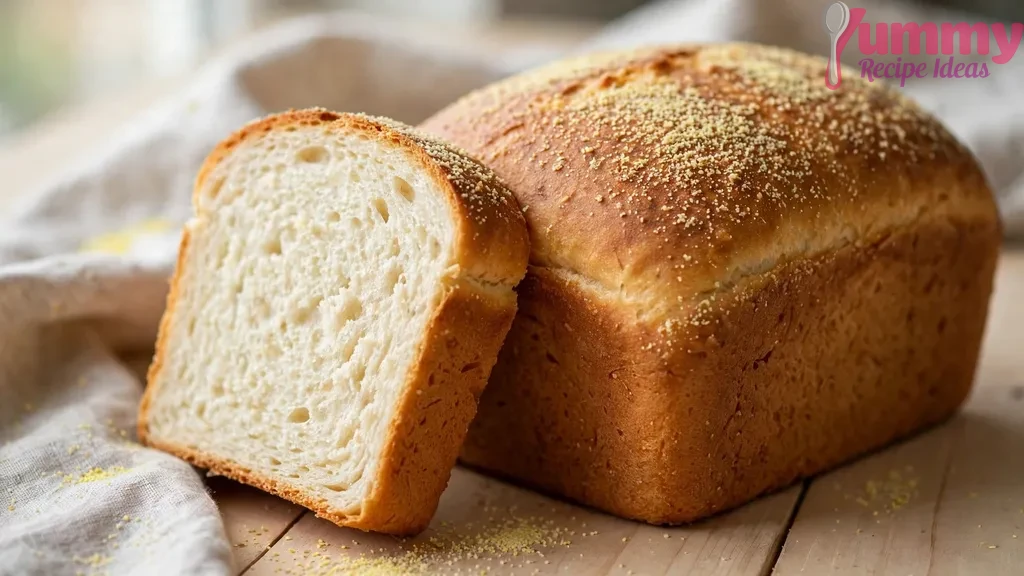
This Gordon Ramsay white bread recipe turns a handful of pantry staples into a bakery-style French loaf in about 3 hours 45 minutes, and it costs roughly $2.00 for the whole loaf — under 20 cents a slice. The secret is Ramsay’s old Paris trick: a one-hour yeast sponge that builds flavor long before the dough even comes together.
The recipe comes from Ramsay’s Chef’s Secrets cookbook, where he describes this Pain de Mie as “a cross between a brioche and a simple white loaf.” It is the method he learned baking in Paris — first at Le Gavroche, then under Guy Savoy — and the one thing that separates it from every dump-and-knead loaf on the internet is the sponge: yeast, warm milk, and plain flour, left alone for a full hour to wake up and develop flavor before it ever meets salt, sugar, or butter.
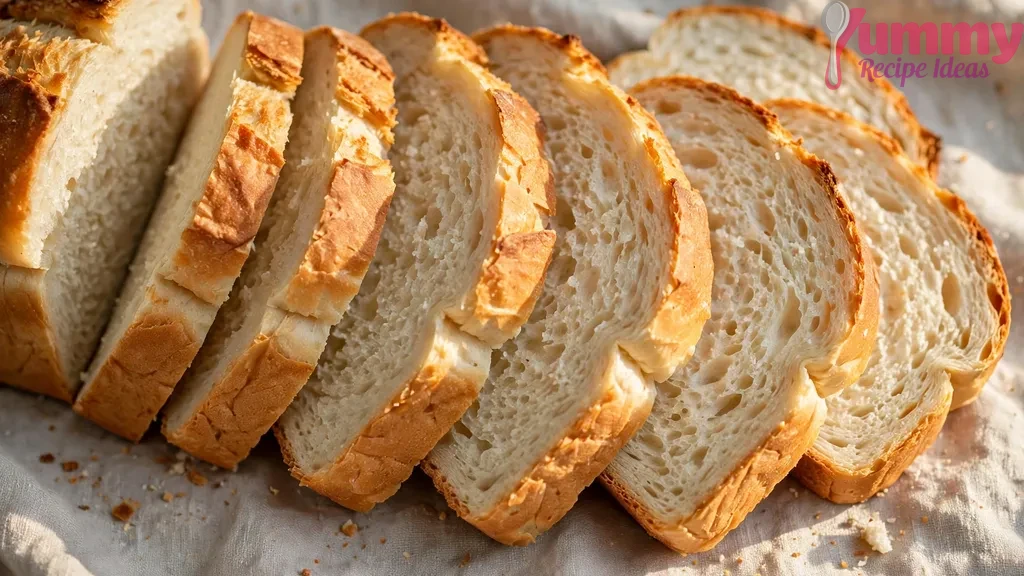
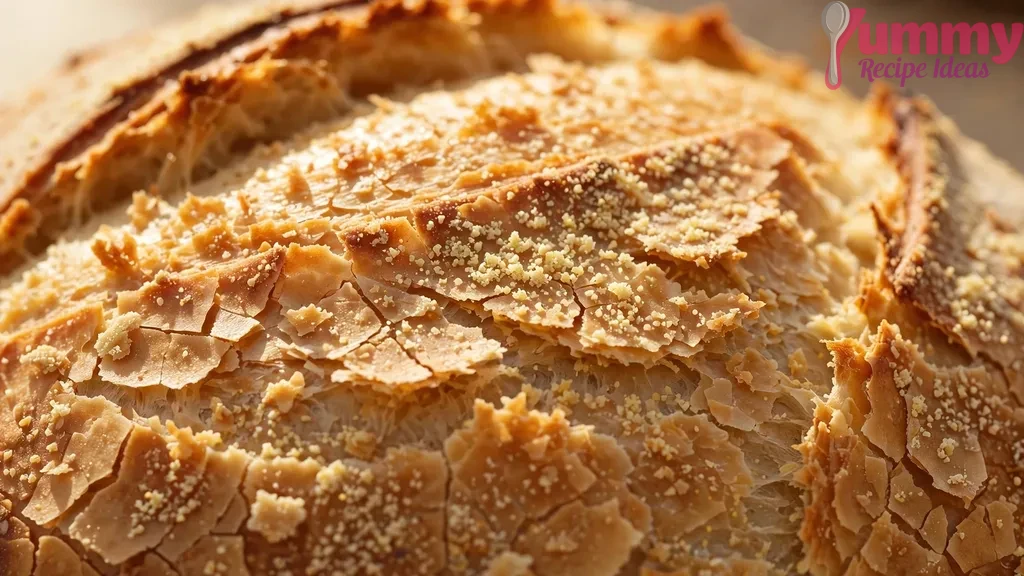
What makes this version better is attention to the details most home recipes skip: two flours used for the right reasons (soft flour for the sponge, strong bread flour for structure), butter rubbed in like pastry for a tender crumb, a semolina-dusted crust that crackles when it cools, and a two-stage bake that starts hot for spring and finishes gentle for a golden, hollow-sounding loaf. Follow the steps as written and you will get a loaf with a soft, even crumb that toasts beautifully — no gummy center, no dense brick.
Cooked this recipe? Send a photo to the team at yummyrecipeideas.com and tell us what you changed — we love sharing reader bakes.
Gordon Ramsay White Bread Recipe
Recipe by Yummy Recipe Ideas | Course: Bread | Cuisine: French | Servings: 12 slices | Prep Time: 25 minutes | Cook Time: 30 minutes | Total Time: 3 hours 45 minutes | Calories: 160 kcal per slice | Difficulty: Medium
A classic French Pain de Mie made Ramsay’s way — a one-hour yeast sponge, two flours, butter rubbed in like pastry, and a semolina-dusted crust. Makes one generous oval loaf that slices beautifully for toast and sandwiches.
Ingredients
For the sponge:
- 1 1/4 tsp active dry yeast (or 1/2 oz fresh yeast, about 1/2 tablespoon)
- 1/2 cup whole milk, warmed to 105–110°F (warm to the touch, not hot)
- 1 cup all-purpose flour
For the dough:
- 1 1/3 cups bread flour
- 1 tsp fine sea salt
- 2 tsp granulated sugar
- 1 1/2 tbsp cold unsalted butter, cut into small pieces
- 1/4 cup cold milk
- 2 tbsp semolina, for dusting
- 1 tsp neutral oil (canola or vegetable), for greasing
Directions
- Build the sponge: Pour the warmed milk into a large mixing bowl and whisk in the yeast until dissolved. Stir in the 1 cup of all-purpose flour until you have a smooth, thick batter. Cover the bowl and leave it in a warm spot for 1 hour — it should be puffy and smell pleasantly yeasty.
- Rub in the butter: In a separate large bowl, whisk together the bread flour and salt. Add the cold butter pieces and rub them in with your fingertips, the way you would for pastry, until the mixture looks like coarse crumbs. Stir in the sugar and make a deep well in the center.
- Bring the dough together: Scrape the sponge and the 1/4 cup of cold milk into the well. Stir with a wooden spoon until a shaggy dough forms, then turn it out onto a very lightly floured surface.
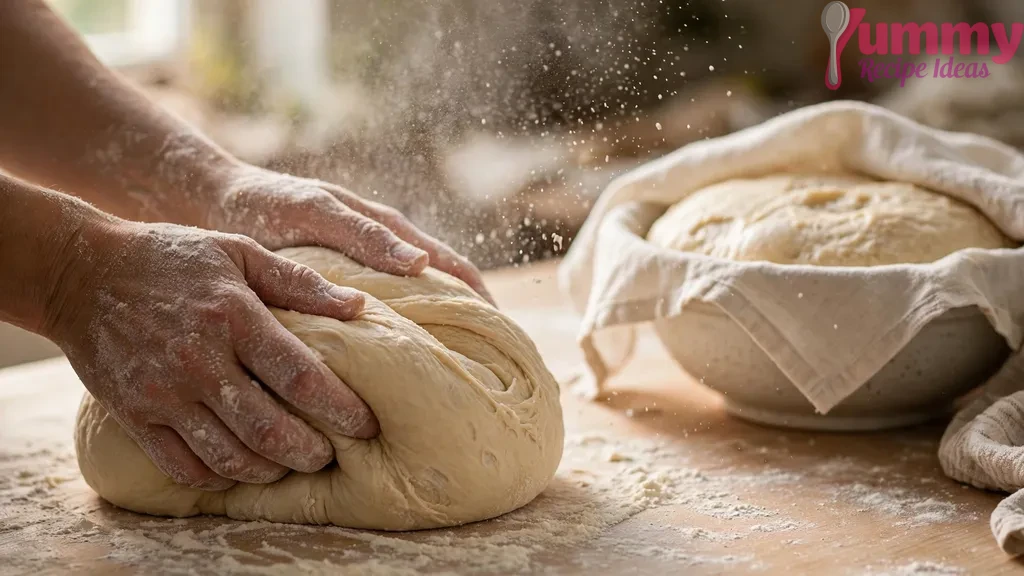
- Knead until smooth: Knead 8–10 minutes until smooth and elastic — the dough is ready when a thumbprint springs back about halfway.
- First rise: Lightly oil a clean bowl, place the dough in it, cover, and leave in a warm spot for about 1 hour, until doubled in size.
- Shape and dust: Turn the risen dough out and knock it back gently. Shape into a smooth oval loaf. Press the top into semolina and place semolina-side up on an oiled, semolina-dusted baking sheet.
- Final proof: Cover loosely and leave to prove 45–60 minutes, until doubled again. Near the end, preheat the oven to 400°F.
- Bake hot, then finish gentle: Mist the baking sheet with cold water; bake 10 minutes at 400°F, then reduce to 350°F and bake 18–22 minutes more, until deep golden and hollow-sounding when tapped on the base. Cool fully on a wire rack before slicing.
FAQs
Why does Ramsay start with a sponge instead of mixing everything at once?
Most home bread recipes dump yeast, flour, salt, and fat into one bowl and hope for the best. Ramsay’s sponge method — whisking the yeast into warm milk with plain flour and giving it a full hour alone — is a professional bakery technique he picked up in Paris. During that hour the yeast multiplies and produces complex, slightly sweet, malty flavors a quick mix cannot create. Salt and butter both slow fermentation, so keeping them away during the yeast’s first hour lets it get fully active. The result: noticeably more flavor and a lighter, more even crumb. If you are new to preferments, the visual cues (puffy, bubbly, smelling like a bakery) make this almost impossible to mess up, and the same sponge idea works in enriched doughs like our Paul Hollywood Cinnamon Rolls.
Can I make rolls instead of one big loaf?
Yes. After the first rise, divide the dough into 8 equal pieces (about 2.5 oz each). Shape each into a smooth ball, press the tops into semolina, place semolina-side up on a lined baking sheet 2 inches apart, cover and prove until doubled, about 40–50 minutes. Bake at 400°F for 12–14 minutes. These rolls freeze beautifully; for a sweet cousin, try our Gordon Ramsay Muffins Recipe.
Why does the recipe use two different flours?
The sponge uses all-purpose flour because it is softer and easier for the yeast to feed on during its first hour. The main dough uses bread flour (around 12–13% protein), which builds the strong gluten network behind the loaf’s structure, chew, and tall rise. One flour for everything works, but you compromise: all-purpose alone gives a weaker, flatter loaf. For other bakes where flour choice matters, see our Pizza Ranch Cactus Bread Recipe.
Why did my loaf come out dense or gummy?
Four culprits cover nearly every dense loaf. First, the sponge was skipped or rushed. Second, under-kneading — if the dough tears instead of stretching, the gluten network cannot trap gas. Third, milk over about 115°F kills yeast on contact. Fourth, slicing too soon traps steam inside. Always cool on a wire rack for at least an hour. Dense flatbreads are a different skill — our Sonoran-Style Tortillas Recipe is good practice for quick doughs.
How should I store it, and does it freeze well?
At its peak on baking day and the day after. Store cut-side down on a wooden board or in a paper bag at room temperature up to 2 days — never refrigerate, as the cold accelerates staling. For longer storage it freezes exceptionally well: slice the cooled loaf, stack with parchment between slices, and freeze up to 3 months; toast from frozen. Day-old slices make outstanding toast points under our Gordon Ramsay Chicken Liver Pate.
What does Ramsay serve this bread with?
In Chef’s Secrets this Pain de Mie is a true table bread. Its soft crumb and crisp semolina crust make it ideal for mopping up rich sauces and soups. Serve thick slices alongside our Gordon Ramsay BBQ Sauce Recipe with grilled meats. It toasts to a deep golden crunch. For breakfast, thick-cut slices with salted butter and jam. If you want a bread built for dipping, our Pizza Ranch Cactus Bread Recipe is the fun, cheesy alternative.
About Yummy Recipe Ideas
Yummy Recipe Ideas tests and adapts chef-inspired recipes for real American home kitchens — with US measurements, realistic timings, and step-by-step photos, so every bake works the first time.
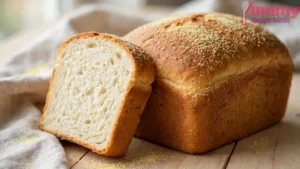
Gordon Ramsay White Bread Recipe
Ingredients
Equipment
Method
- Build the sponge: Pour the warmed milk into a large mixing bowl and whisk in the yeast until dissolved. Stir in the 1 cup of all-purpose flour until you have a smooth, thick batter. Cover the bowl and leave it in a warm spot for 1 hour — it should be puffy and smell pleasantly yeasty.
- Rub in the butter: In a separate large bowl, whisk together the bread flour and salt. Add the cold butter pieces and rub them in with your fingertips, the way you would for pastry, until the mixture looks like coarse crumbs. Stir in the sugar and make a deep well in the center.
- Bring the dough together: Scrape the sponge and the 1/4 cup of cold milk into the well. Stir with a wooden spoon until a shaggy dough forms, then turn it out onto a very lightly floured surface.
- Knead until smooth: Knead 8–10 minutes until smooth and elastic — the dough is ready when a thumbprint springs back about halfway.
- First rise: Lightly oil a clean bowl, place the dough in it, cover, and leave in a warm spot for about 1 hour, until doubled in size.
- Shape and dust: Turn the risen dough out and knock it back gently. Shape into a smooth oval loaf. Press the top into semolina and place semolina-side up on an oiled, semolina-dusted baking sheet.
- Final proof: Cover loosely and leave to prove 45–60 minutes, until doubled again. Near the end, preheat the oven to 400°F.
- Bake hot, then finish gentle: Mist the baking sheet with cold water; bake 10 minutes at 400°F, then reduce to 350°F and bake 18–22 minutes more, until deep golden and hollow-sounding when tapped on the base. Cool fully on a wire rack before slicing.
