
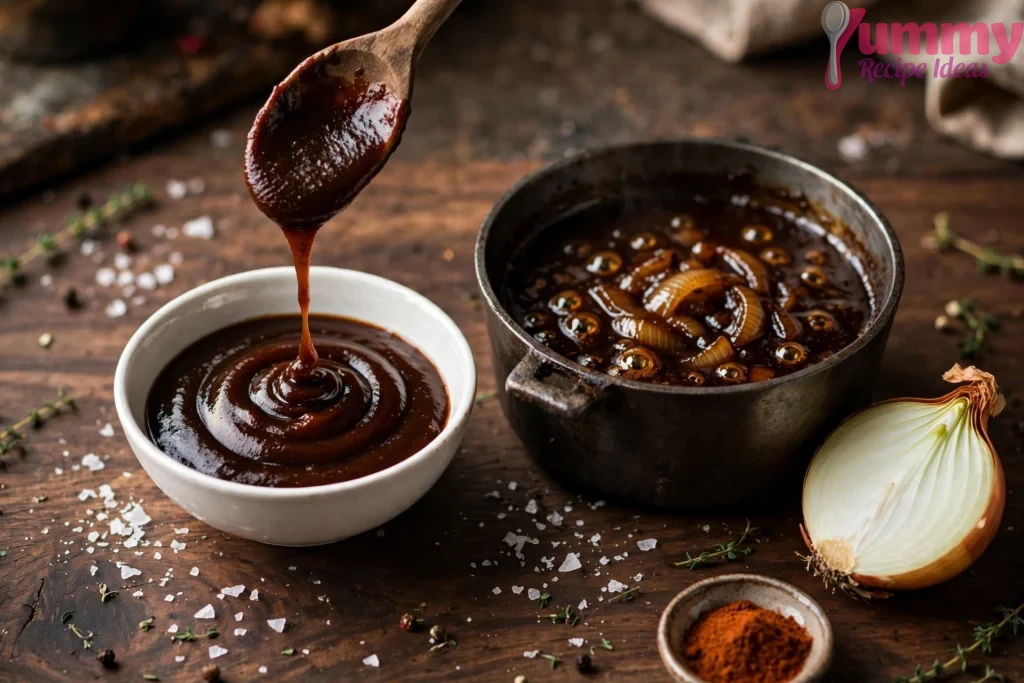
Gordon Ramsay’s homemade BBQ sauce is smoky, sweet and sharp — caramelised onions and smoked paprika toasted in the pan before any liquid goes in, finished with cider vinegar and ketchup into a thick, glossy sauce. It is ready in 30 minutes for about $0.35 a serving and roughly 130 calories a serving.
This is his BBQ sauce from Ultimate Cookery Course, made for smoky pork sliders, and the standout technique is the caramelisation: the onions cook with brown sugar for 10 to 15 minutes before anything wet touches the pan, and the smoked paprika is toasted in the hot fat with them. In Ramsay’s own words from the show, the secret of a good barbecue sauce is “that really important caramelisation” — because paprika toasted in fat turns deep and rounded, while paprika dumped into simmering liquid stays dusty and flat.
This version goes further than the usual throw-everything-in-a-pan recipes, which taste like sweetened ketchup. The brown sugar melts into the onions to build a dark, sticky body; the cider vinegar is deglazed so it hisses up every browned bit instead of tasting raw; and there is an optional espresso shot stirred in with the ketchup — Ramsay’s own restaurant upgrade, which adds a bitter edge that balances the sweetness. One small saucepan, one jar, and a sauce that tastes nothing like the bottle.
Cooked this recipe? Send a photo — we’d love to feature your version!
Gordon Ramsay BBQ Sauce
Recipe by Yummy Recipe Ideas · Course: Condiment, Sauce · Cuisine: American, British · Servings: 4 · Prep: 5 min · Cook: 25 min · Total: 30 min · Calories: 130 kcal · Difficulty: Easy
Homemade barbecue sauce with caramelised onions, smoked paprika, cider vinegar and ketchup — ready in 30 minutes for about $0.35 a serving. Makes about 1 1/2 cups.
Ingredients
Equipment
Method
- Sweat the aromatics: Heat the olive oil in a small heavy-bottomed saucepan over medium heat. Add the diced onion, chopped garlic and 1/2 tsp kosher salt; cook 4-5 minutes, stirring often, until soft and translucent.
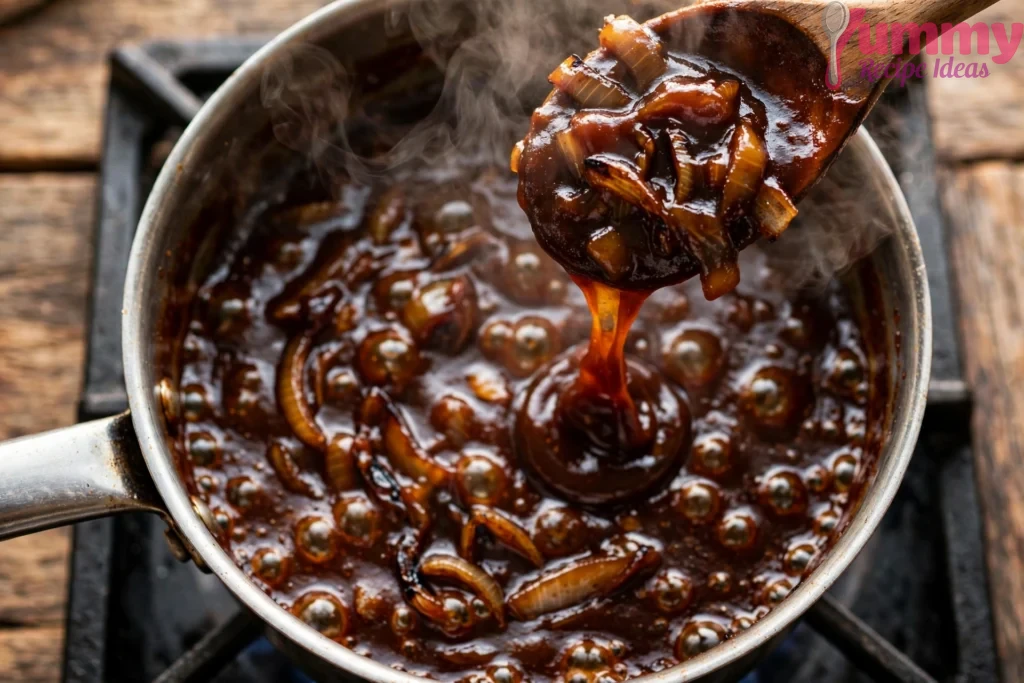
- Caramelise the base: Stir in the brown sugar and smoked paprika. Lower the heat to medium-low and cook 10-12 minutes, stirring often, until the onions are deeply golden, sticky and sweet-smelling and the paprika has toasted in the fat. Do not rush this step — burnt sugar goes bitter.
- Deglaze with the acid: Pour in the cider vinegar — it will hiss and steam. Scrape up every browned bit from the bottom of the pan and cook 1-2 minutes until the sharp vinegar smell cooks off.
- Build the sauce: Stir in the Worcestershire sauce, ketchup and the espresso, if using. Lower the heat and simmer gently 8-10 minutes, stirring occasionally, until thick, dark and glossy — it should coat the back of a spoon and hold a trail when you drag the spoon through it.
- Blend for a silky finish (optional): For a restaurant-smooth sauce, buzz briefly with an immersion blender. Leave it chunky if you like the caramelised-onion texture.
- Taste and jar: Season with salt and plenty of black pepper. Cool completely, then pour into a clean glass jar with a lid. Keeps in the fridge up to 2 weeks.
Ingredients
For the sauce:
- 1 tbsp olive oil
- 1 small onion (about 4 oz), peeled and finely diced
- 2 garlic cloves, peeled and finely chopped
- 1/2 tsp kosher salt, plus more to taste
- 2 tbsp packed light brown sugar
- 1 1/2 tsp smoked paprika
- 2 tbsp apple cider vinegar
- 2 tsp Worcestershire sauce
- 3/4 cup tomato ketchup
- 1 tbsp freshly brewed espresso, cooled (optional — the restaurant upgrade)
- Freshly ground black pepper
Directions
- Sweat the aromatics: Heat the olive oil in a small heavy-bottomed saucepan over medium heat. Add the diced onion, chopped garlic and 1/2 tsp kosher salt, and cook for 4 to 5 minutes, stirring often, until soft and translucent.
- Caramelise the base: Stir in the brown sugar and smoked paprika. Lower the heat to medium-low and cook for 10 to 12 minutes, stirring often, until the onions are deeply golden, sticky and sweet-smelling and the paprika has toasted in the fat. Do not rush this step — this caramelisation is the whole sauce, and burnt sugar goes bitter.
- Deglaze with the acid: Pour in the cider vinegar — it will hiss and steam. Scrape up every browned bit from the bottom of the pan and cook for 1 to 2 minutes until the sharp vinegar smell cooks off.
- Build the sauce: Stir in the Worcestershire sauce, ketchup and the espresso, if using. Lower the heat and simmer gently for 8 to 10 minutes, stirring occasionally, until thick, dark and glossy — it should coat the back of a spoon and hold a trail when you drag the spoon through it.
- Blend for a silky finish (optional): For a restaurant-smooth sauce, buzz it briefly with an immersion blender. Leave it chunky if you like the caramelised-onion texture.
- Taste and jar: Season with salt and plenty of black pepper. Cool completely, then pour into a clean glass jar with a lid. Keeps in the fridge for up to 2 weeks.
FAQs
Why does Ramsay caramelise the onions for so long?
Because this sauce has no simmered-down tomato base to hide behind — the caramelised onion IS the sauce’s body. Ramsay fries the onions with brown sugar, adds the paprika, then cooks for another 10 to 12 minutes before any liquid touches the pan. That long dry caramelisation does two jobs at once. First, the sugar melts into the onions and creates a dark, sticky base that gives the sauce its thickness and its deep sweet-savoury flavor. Second, the smoked paprika toasts in the hot fat coating the onions, which cracks open its essential oils and turns it from dusty powder into deep, rounded smokiness. Cooked-out spice tastes rounded and warm; raw spice tastes flat and gritty — it is the same fat-first logic behind our Gordon Ramsay Meatball Soup, where the cumin toasts in rendered beef fat. Keep the heat at medium-low for the caramelisation, stir often, and pull the pan off if anything catches — burnt sugar goes bitter and there is no recovering it.
What does coffee do in BBQ sauce — and is it optional?
It is optional, but it is Ramsay’s own restaurant upgrade, so it is worth knowing about. On Kitchen Nightmares he adds ground coffee alongside the other sauce ingredients, and his restaurant pork-ribs recipe confirms a shot of strong espresso in the sauce. Coffee does something no other ingredient can: its bitterness deepens the smokiness and cuts through the sweetness of the sugar and ketchup, so the sauce tastes complex instead of just sweet. You do not taste coffee — you taste depth. If you want the upgrade, stir 1 tbsp of cooled brewed espresso (or 1 tsp instant coffee dissolved in 1 tbsp hot water) in with the ketchup. Do not add more; above a tablespoon the coffee starts announcing itself. No coffee around? The sauce is still excellent without it — the caramelised onion and smoked paprika carry the flavor. And if you like layered condiments in general, our Gordon Ramsay Basil Pesto is another fridge staple worth keeping next to this jar.
How is this different from a bottle of store-bought BBQ sauce?
Store-bought sauce is engineered for shelf life: ketchup-sweet, one-note, and often thickened with corn syrup or modified starch instead of real caramelised flavor. This homemade version tastes different in three ways you can actually feel. First, the caramelised onion base gives it a natural sweetness with depth — it is sweet because onions went slowly golden, not because syrup was poured in. Second, the smoked paprika is toasted in fat before liquid hits the pan, so the smokiness is rounded and warm instead of the sharp, artificial smoke flavor of bottled sauces. Third, you control the balance: more vinegar if you like it sharp, more sugar if you like it sticky. Cost is the other difference — a jar like this costs about $1.30 to make, roughly a third of a premium small-batch bottle, and about $0.35 a serving. The tradeoff is 30 minutes of your time and a fridge shelf, which the flavor pays back many times over.
How long does homemade BBQ sauce keep — and can it be frozen?
It keeps far better than you would expect for a homemade sauce, because almost every ingredient is a natural preservative: the sugar, the vinegar and the ketchup all slow down spoilage. In a clean sealed jar in the fridge it stays good for up to 2 weeks — use a clean spoon every time so you do not introduce bacteria. The flavor actually improves over the first 24 hours as the smoke and acid settle into the sauce, so make it a day ahead if you can. It also freezes beautifully for up to 3 months: leave an inch of headspace in the jar so the sauce has room to expand, thaw overnight in the fridge, and give it a good stir before serving. One thing to skip is canning-style room-temperature storage — without proper acid and processing control, the fridge (or freezer) is where this sauce belongs.
What does Ramsay serve BBQ sauce with — and what else can I use it for?
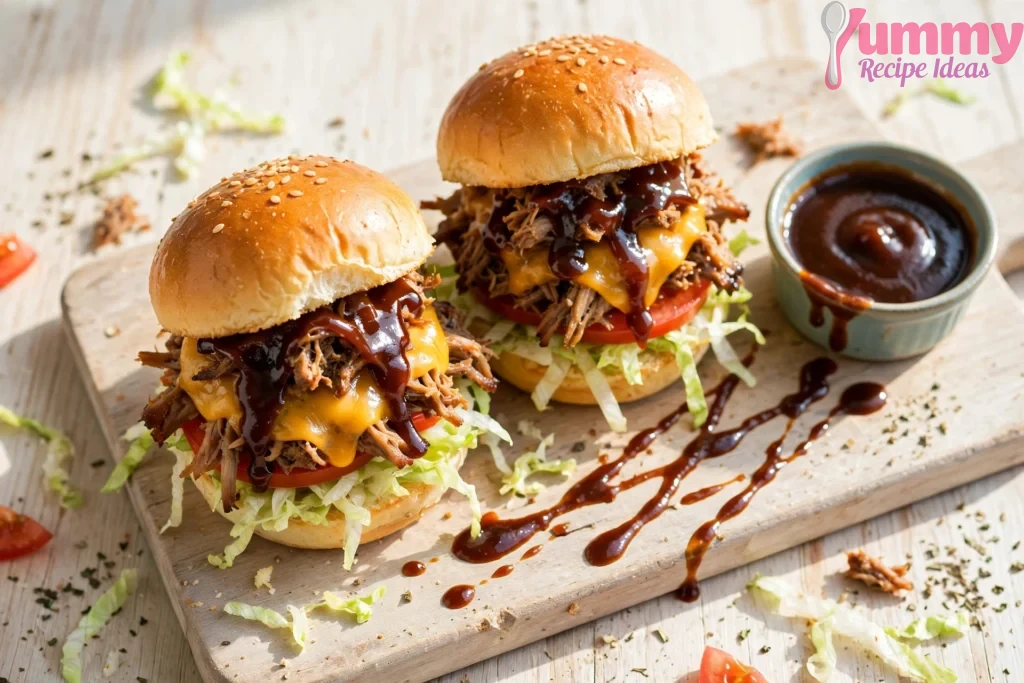
In Ultimate Cookery Course Ramsay layers this sauce inside smoky pork sliders with smoked cheddar, shredded lettuce and tomato, and that is the move to copy first — the sweet-sharp sauce against rich pulled pork is exactly what it was built for. But a jar this good should not sit idle between slider nights. Brush it over grilled chicken thighs or ribs in the last few minutes of cooking so the sugar caramelises without burning; spoon it over a smash burger; stir a spoonful into baked beans for instant depth; or use it as a dip for sweet potato fries. It also works as a glaze for meatloaf — brush it on for the last 15 minutes of baking. If you want another homemade condiment to keep beside it, our Gordon Ramsay Basil Pesto is the savory counterpoint, and a swirl of this BBQ sauce also lifts the Gordon Ramsay Meatball Soup if you like your soup extra smoky.
How much does it cost to make?
About $1.30 for the whole jar — roughly $0.35 a serving of 6 tablespoons, which makes 4 generous servings from the batch. The ketchup is the biggest line item (about $0.35 of a $1.30 batch), with the onion, cider vinegar, brown sugar, Worcestershire and smoked paprika splitting the rest. Pantry staples you already own — olive oil, salt, pepper — are nearly free per batch. Compare that to a premium small-batch BBQ sauce at $4 to $6 a bottle, and the homemade version runs about a third of the price while tasting better. The optional espresso adds roughly 5 cents. If you double the recipe for a cookout crowd (it doubles cleanly — just use a bigger pan), the per-serving cost drops under $0.30, because the onions and ketchup are the only costs that scale.
About Yummy Recipe Ideas: We test and share easy, flavor-packed recipes inspired by the world’s best chefs — written for real home kitchens with US measurements and honest costs. New recipes every day.
