
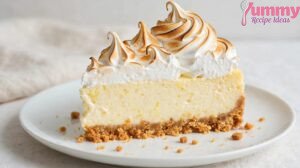
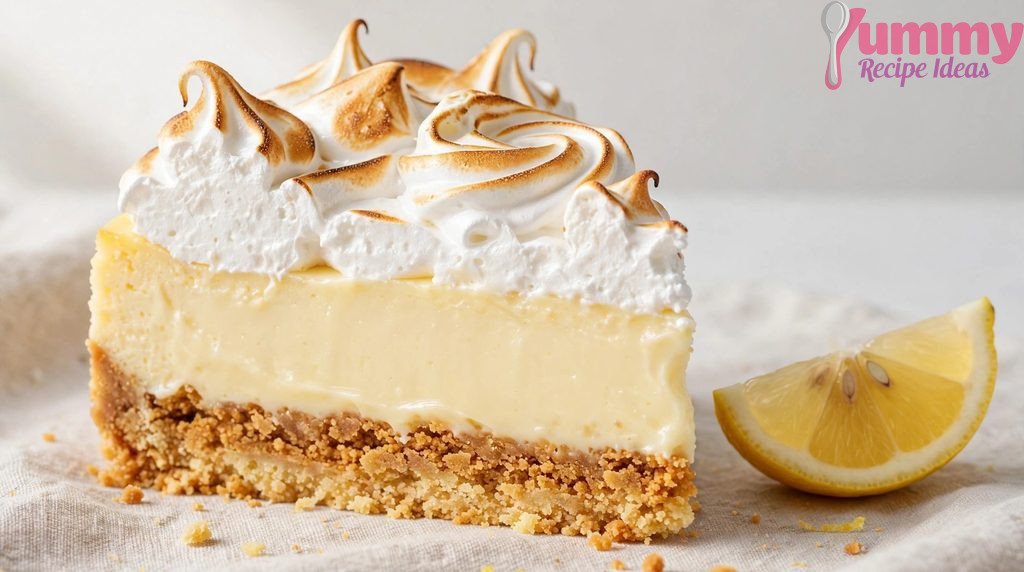
This Gordon Ramsay Lemon Meringue Cheesecake Recipe needs about 35 minutes of hands-on work, an hour in the oven, and an overnight chill — a baked lemon cheesecake on a crisp biscuit base, finished with a torched cloud of golden meringue, for about $1.50 a serving and roughly 450 calories a slice.
Lemon meringue pie was Ramsay’s childhood favorite, but he fell out with the classic cornflour-set lemon layer — its texture put him off. His answer was to move the lemon where it belongs: straight into a baked cheesecake. All the sharpness of fresh zest and juice lives in the creamy filling, built the way he flavors his lemon tart, while the meringue gets torched on top like the one on his crème brûlée-style puddings.
What makes this version better than the classic pie — and better than most cheesecakes — is the discipline in the details: the hot biscuit base is sealed with egg white so it stays crisp under a wet filling, the oven is switched off and left ajar so the cheesecake cools gently and never cracks, and the meringue is whipped with warm sugar so it holds glossy, sliceable peaks. Follow those three moves and you get a dessert that looks like it came from a restaurant pass.
Made this cheesecake? Leave a comment below and tell us how it turned out — we read every single one.
Jump to: Recipe Card | Ingredients | Directions | FAQs
Gordon Ramsay Lemon Meringue Cheesecake Recipe
By Yummy Recipe Ideas | No ratings yet
Course: Dessert | Cuisine: British | Difficulty: Medium
Servings: 12 slices | Prep: 35 min | Cook: 55 min | Chill: Overnight (at least 8 hours) | Total: 1 hr 30 min | Calories: ~450 per slice
A baked lemon cheesecake on a sealed biscuit base, chilled overnight until silk-smooth, then crowned with a billowing meringue torched to golden peaks. Sharper than lemon meringue pie, creamier than plain cheesecake.
Gordon Ramsay Lemon Meringue Cheesecake Recipe
Ingredients
Equipment
Method
- Make and bake the base: Heat the oven to 325F. Blitz the biscuits to fine crumbs, toss with the melted butter until every crumb looks like damp sand, and press firmly over the bottom of a 9-inch springform pan with the back of a measuring cup. Bake 10 minutes, brush the hot base with the beaten egg white, and return to the oven for 2 minutes to seal. Cool completely.
- Beat the filling gently: Drop the oven to 300F. Beat the cream cheese until completely smooth, then beat in the sugar, cornstarch and salt. Add the eggs and yolk one at a time on low speed, scraping the bowl after each – do not whip in air. Stir in the sour cream, lemon zest, lemon juice and vanilla until just combined.
- Bake low and slow: Pour the filling over the cooled base and smooth the top. Bake 50 to 55 minutes, until the edges are set but the center still has a slight wobble when you nudge the pan.
- Cool it the Ramsay way: Turn the oven off, prop the door open with a wooden spoon, and leave the cheesecake inside for 1 hour. Then refrigerate overnight, at least 8 hours, to set fully. Run a thin knife around the edge before releasing the springform.
- Whip the meringue fresh: Just before serving, whisk the egg whites with the cream of tartar to soft peaks. Add the warm sugar a spoonful at a time, whisking to stiff, glossy peaks that hold their shape.
- Pile, swirl and torch: Spoon the meringue onto the cold cheesecake and swirl into tall peaks with the back of a spoon. Torch until golden, moving constantly, or broil 2 to 3 minutes watching closely. Slice with a hot, dry knife and serve immediately.
Ingredients
For the biscuit base:
- 2 cups digestive biscuit crumbs (about 14 biscuits; graham cracker crumbs work too)
- 1/4 cup (1/2 stick) unsalted butter, melted
- 1 large egg white, lightly beaten
For the lemon filling:
- 3 (8-oz) blocks full-fat cream cheese (24 oz total), at room temperature
- 3/4 cup sour cream, at room temperature
- 3/4 cup granulated sugar
- 2 tbsp cornstarch
- 1/4 tsp fine sea salt
- 3 large eggs, plus 1 yolk, at room temperature
- Finely grated zest of 2 lemons
- 1/4 cup plus 1 tbsp fresh lemon juice (about 2 lemons)
- 1 tsp pure vanilla extract
For the meringue:
- 4 large egg whites, at room temperature
- 3/4 cup granulated sugar
- 1/4 tsp cream of tartar
Directions
- Make and bake the base: Heat the oven to 325°F. Blitz the biscuits to fine crumbs in a food processor, toss with the melted butter until every crumb looks like damp sand, and press firmly over the bottom of a 9-inch springform pan using the back of a measuring cup. Bake for 10 minutes, then brush the hot base all over with the beaten egg white and return it to the oven for 2 minutes to seal. Leave to cool completely — the seal is what keeps the crust crisp under the wet filling.
- Beat the filling — gently: Drop the oven to 300°F. Beat the cream cheese in a large bowl until completely smooth, then beat in the sugar, cornstarch and salt. Add the eggs and yolk one at a time on low speed, scraping down the bowl after each — do not whip in air or the cheesecake will puff and crack. Stir in the sour cream, lemon zest, lemon juice and vanilla until just combined.
- Bake low and slow: Pour the filling over the cooled base and smooth the top. Bake for 50 to 55 minutes, until the edges are set but the center still has a slight wobble when you nudge the pan. That wobble is correct — it finishes setting as it cools.
- Cool it the Ramsay way: Turn the oven off, prop the door open with a wooden spoon, and leave the cheesecake inside for 1 hour. The gentle leftover heat lets the middle set at the same pace as the edges, which is what prevents cracks. Then refrigerate overnight, at least 8 hours, so it sets fully. Run a thin knife around the edge before releasing the springform.
- Whip the meringue fresh: Just before serving, warm the 3/4 cup sugar in a low oven (about 200°F) for 5 minutes — warm sugar dissolves faster and makes a stabler meringue. Whisk the egg whites with the cream of tartar to soft peaks, then add the warm sugar a spoonful at a time, whisking to stiff, glossy peaks that hold their shape.
- Pile, swirl and torch: Spoon the meringue onto the cold cheesecake and swirl it into tall peaks with the back of a spoon. Torch until golden, moving constantly so no spot scorches — or slide it under a hot broiler for 2 to 3 minutes, standing there and watching, because it goes from gold to burnt in seconds. Slice with a hot, dry knife and serve immediately.
FAQs
Why does this cheesecake cool in a turned-off oven? Won’t it crack anyway?
Cooling too fast is the number-one cause of cracked cheesecake. The edges firm up while the center is still loose, and that tug between the two splits the surface as it sets. Switching the oven off and leaving the door ajar bathes the cheesecake in gentle, falling heat, so the middle finishes setting at the same pace as the edges instead of fighting them. After the hour in the warm oven it goes into the fridge overnight, and the slow, even chill keeps the top flawless. It is the same trick Ramsay uses on his lemon tart, and it works on anything custardy. Two more crack-proofing rules: beat the filling on low speed so you don’t whip in air (air expands in the heat and then collapses), and don’t overbake — the center should still wobble slightly when you take it out. A wobbling center sets up perfectly in the fridge; a fully firm one is already on its way to cracking.
Should I torch the meringue or use the broiler?
A kitchen torch wins for control — you can brown each peak exactly where you want it, without heating the chilled cheesecake underneath. No torch? A hot broiler works fine: slide the finished cheesecake 6 inches under the heat for 2 to 3 minutes and stand there watching, because meringue goes from golden to burnt in seconds. Either way, whip the meringue and brown it right before serving. Meringue left sitting on a cold cheesecake slowly weeps a sugary syrup, which makes the peaks slide and dulls the golden color. If you love this kind of cloud-topped dessert, try our Gordon Ramsay Raspberry Soufflé Recipe next — the same egg-white whisking discipline carries straight over to a perfect soufflé rise.
Why is there no separate lemon layer like classic lemon meringue pie?
Because this recipe replaces the pie filling with cheesecake itself, and that’s the whole point. The classic lemon meringue pie uses a cornflour-set lemon layer that can taste starchy and rubbery — Ramsay himself went off its texture years ago. Here the lemon lives directly in the filling: plenty of fresh zest and juice beaten into cream cheese and sour cream, so every bite is sharp and bright instead of just the top layer being tart. You get a cleaner lemon flavor and a far creamier bite, plus none of the weeping or gumminess that cornstarch fillings develop overnight. If you genuinely prefer the traditional version with the set lemon curd inside pastry, that’s a different dessert — this one is for people who want lemon meringue flavor with cheesecake luxury.
Can I make the cheesecake ahead of time?
The cheesecake itself is better made ahead — in fact it needs to be. Bake it a day before you serve it and let it chill overnight; the long rest is what gives you that dense, silk-smooth slice. The base and filling can be done up to two days ahead and kept covered in the fridge once unmolded. The meringue is the only part you can’t do early: it must be whipped, piled on and torched just before serving, or it weeps syrup onto the cold cheesecake and the peaks go sad. So plan it as a two-day dessert — cheesecake on day one, meringue on the day you serve. If you need a dessert you can finish completely in advance for a crowd, pair this with something that holds beautifully: our Gordon Ramsay Apple Pie Recipe is just as good on day two and makes a great one-two dessert table with this cheesecake.
How much does this lemon meringue cheesecake cost to make?
Roughly $18 for the whole cheesecake, or about $1.50 a slice for 12 generous servings — genuinely cheap for a dessert that looks this impressive. The priciest item is the cream cheese: three 8-oz blocks at about $2.50 each. After that, a tub of sour cream, a dozen eggs, sugar, butter, biscuits and three lemons keep the rest under $10, assuming a basic stocked pantry for salt, cornstarch and vanilla. Compare that to a bakery cheesecake at $25-plus with a plain top, and you’re saving money while getting the torched meringue showpiece. Feeding a bigger crowd on the same budget? Add our Gordon Ramsay Chocolate Cake Recipe — a full cake for roughly the same $15–18, and the two desserts together will cover every sweet tooth at the party.
About the Author
Yummy Recipe Ideas — We test Gordon Ramsay-inspired recipes in a real home kitchen and rewrite them for US cooks: cups and tablespoons, honest timings, and step-by-step photos, so every dish works the first time you make it.
