
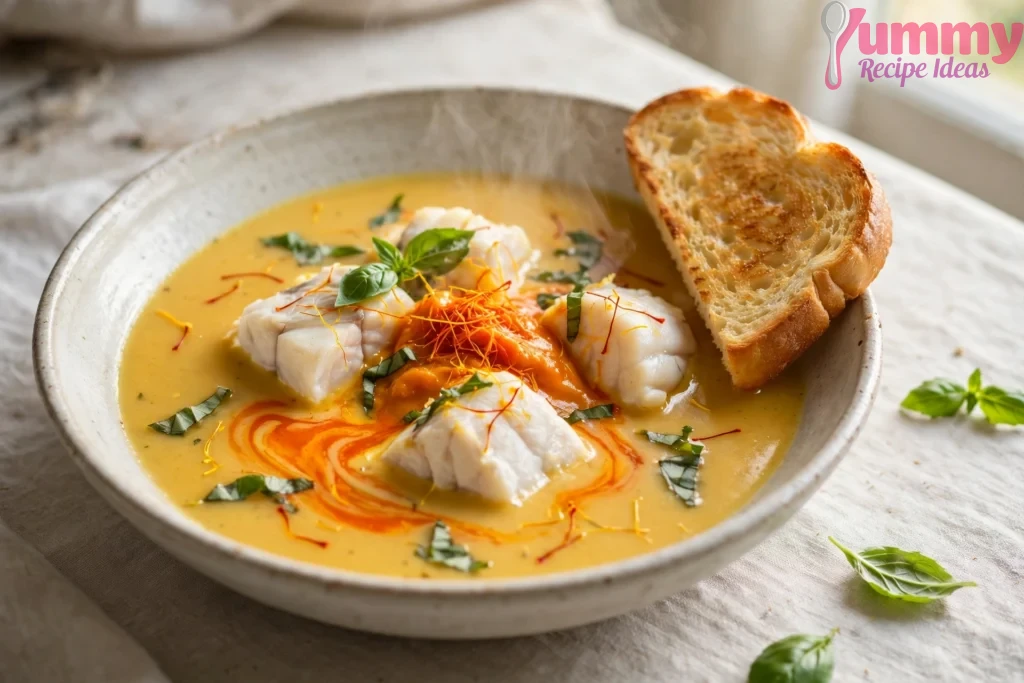
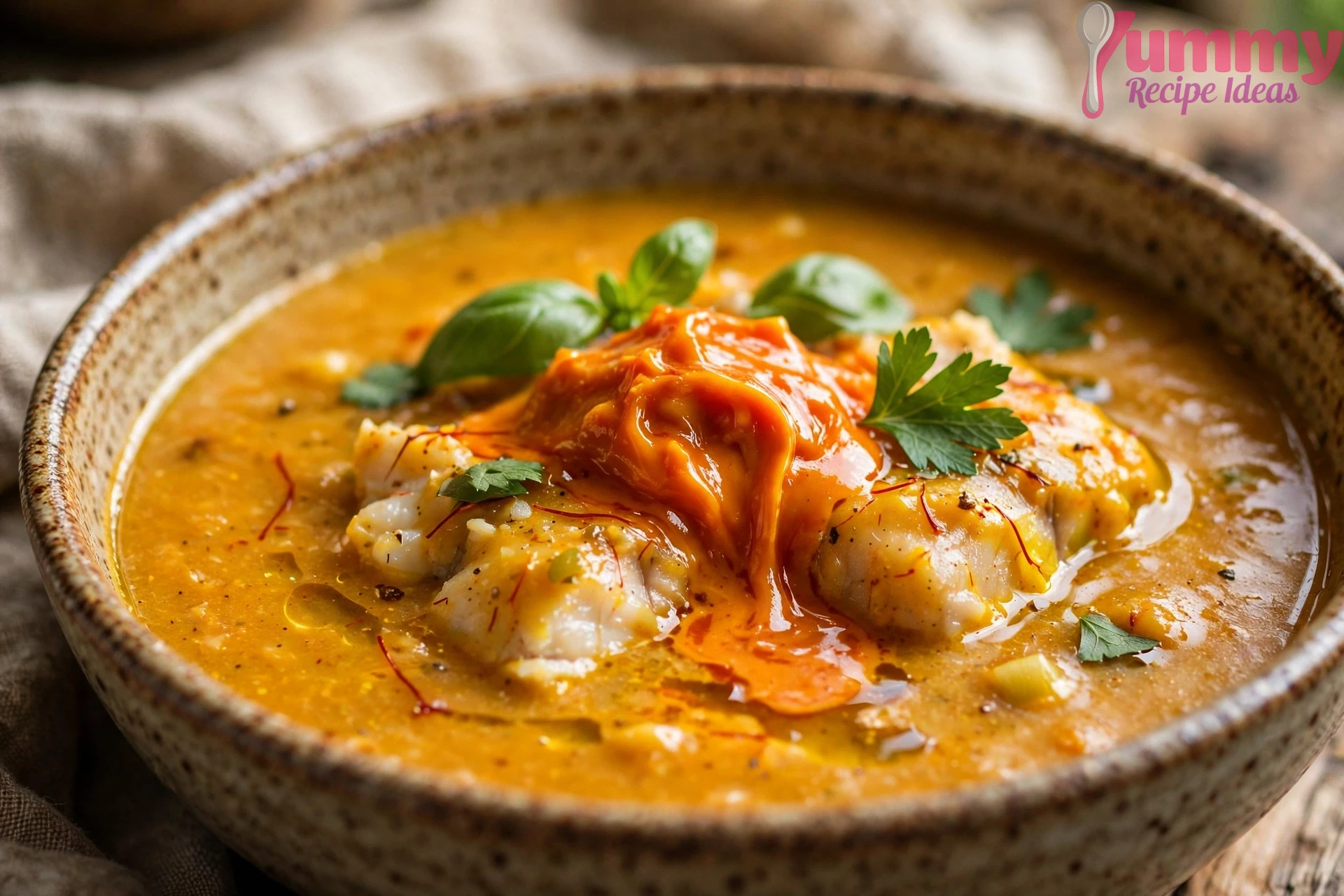
This Gordon Ramsay bouillabaisse recipe is the French fish stew that ruins restaurant versions for you: a rich, saffron-gold broth with a triple hit of anise from fennel, star anise and Pernod, crowned with chunks of seared white fish and a dollop of homemade saffron rouille. It looks like a special-occasion dish, takes 55 minutes, and costs about $6 a serving — a fraction of the bistro price.
This is his version from The F Word, where he calls bouillabaisse “one of my favourite French fish dishes” and builds it the smart way: the fish gets seared hard first for deep golden color, then the whole pot simmers and gets blended into a thick, silky broth. That searing step is what separates his method from the usual dump-everything-in approach — it builds a layer of caramelized flavor that simmering alone can never create. The rouille follows his Saffron Mayonnaise from Quick and Delicious: saffron ground to a powder in a mortar and steeped in hot water first, because that is how you “get the maximum flavour out of this expensive spice.”
What makes this Gordon Ramsay bouillabaisse recipe better than most home bouillabaisse recipes is the finishing discipline. The star anise comes out before blending so the anise stays elegant, not medicinal; the broth gets seasoned only after blending, when you can actually taste its true concentration; and the rouille is whisked by hand so it stays glossy and stable. Add a slice of griddled sourdough for dragging through the rouille, and you have a bowl that tastes like a long lunch in Marseille — made in one pot, on a Tuesday.
Cooked this Gordon Ramsay bouillabaisse recipe? Send a photo — we’d love to feature your version!
Gordon Ramsay Bouillabaisse Recipe
Recipe by Yummy Recipe Ideas · Course: Main Dish · Cuisine: French · Servings: 4 · Prep: 20 min · Cook: 35 min · Total: 55 min · Calories: 430 kcal · Difficulty: Medium
Saffron-spiked French fish stew with seared white fish, triple-anise broth blended silky smooth, and homemade saffron rouille. Serves 4 as a main course.
Ingredients
For the bouillabaisse:
- 1 1/4 lb firm white fish fillets (monkfish, sea bass, or cod), skin on, cut into 2-inch chunks
- 1/4 tsp saffron threads, divided
- 3 tbsp olive oil, divided
- 1 1/2 tsp kosher salt, divided
- 1/2 tsp black pepper
- 1/4 tsp cayenne pepper
- 1 fennel bulb, trimmed and thinly sliced
- 2 carrots, peeled and diced (about 1 cup)
- 2 celery ribs, sliced (about 1 cup)
- 1 whole star anise
- 4 garlic cloves, crushed
- 3 medium shallots, thinly sliced (about 1 cup)
- 2 tbsp Pernod
- 2/3 cup dry white wine
- 12 oz Yukon Gold potatoes, peeled and diced (about 2 1/2 cups)
- 2 cups fish stock
- 1 (14-oz) can diced tomatoes
- 1/4 cup torn fresh basil leaves, plus more to serve
- 2 tbsp chopped flat-leaf parsley
For the saffron rouille:
- Generous pinch of saffron threads
- 1 tbsp boiling water
- 2 egg yolks, at room temperature
- 2 small garlic cloves, crushed
- 1 tbsp Dijon mustard
- 1/3 cup extra-virgin olive oil
- 1/3 cup neutral oil (avocado or grapeseed)
- 1 tsp fresh lemon juice, plus more to taste
- 1/4 tsp kosher salt
To serve:
- 4 thick slices crusty bread (sourdough or baguette), grilled or toasted
Directions
- Season and sear the fish: Rub the fish chunks with 1 tbsp of the olive oil, a pinch of saffron, 1 tsp of the salt, the black pepper and the cayenne. Heat a large Dutch oven or heavy pot over medium-high heat with another tablespoon of oil and sear the fish skin-side down in a single layer until deeply golden, about 2 minutes per side. Remove to a plate — it will finish cooking later.
- Build the aromatic base: In the same pot, add the remaining tablespoon of oil, the fennel, carrots, celery and the whole star anise. Cook for 4 minutes, scraping up the browned bits from the fish. Add the crushed garlic, sliced shallots and a pinch of cayenne, and cook 2 more minutes until the shallots soften.
- Flambe with Pernod: Return the fish to the pot. Pour in the Pernod and let it bubble hard for about 30 seconds, tilting the pot so the alcohol burns off and lifts all the caramelized flavor off the bottom. Do not skip this — it is where the sharp anise punch comes from.
- Simmer it down: Pour in the white wine, fish stock, diced potatoes, canned tomatoes, basil and parsley. Bring to a boil, then reduce to a steady simmer and cook uncovered for 20 minutes, until the potatoes are completely tender and the fish flakes easily.
- Blend it silky: Fish out and discard the star anise. Blend the soup with an immersion blender until completely smooth and thick — the potatoes and fish break down into the broth and give it its body. Taste and season with the remaining 1/2 tsp salt and more cayenne or lemon if needed.
- Make the rouille: While the soup simmers, grind the saffron to a powder with a mortar and pestle, add the boiling water and let it steep 5 minutes. Whisk the egg yolks with the garlic and Dijon in a bowl, then pour in the two oils in a slow, thin stream, whisking constantly, until thick and glossy. Stir in the saffron water, lemon juice and salt.
- Serve it proud: Ladle the hot soup into warm bowls. Drop a generous spoonful of rouille on top of each, scatter with extra basil, and serve immediately with the griddled toast for dragging through the rouille.

Gordon Ramsay Bouillabaisse Recipe
Ingredients
Equipment
Method
- Season and sear the fish: Rub the fish chunks with 1 tbsp of the olive oil, a pinch of saffron, 1 tsp of the salt, the black pepper and the cayenne. Heat a large Dutch oven or heavy pot over medium-high heat with another tablespoon of oil and sear the fish skin-side down in a single layer until deeply golden, about 2 minutes per side. Remove to a plate — it will finish cooking later.
- Build the aromatic base: In the same pot, add the remaining tablespoon of oil, the fennel, carrots, celery and the whole star anise. Cook for 4 minutes, scraping up the browned bits from the fish. Add the crushed garlic, sliced shallots and a pinch of cayenne, and cook 2 more minutes until the shallots soften.
- Flambe with Pernod: Return the fish to the pot. Pour in the Pernod and let it bubble hard for about 30 seconds, tilting the pot so the alcohol burns off and lifts all the caramelized flavor off the bottom. Do not skip this — it is where the sharp anise punch comes from.
- Simmer it down: Pour in the white wine, fish stock, diced potatoes, canned tomatoes, basil and parsley. Bring to a boil, then reduce to a steady simmer and cook uncovered for 20 minutes, until the potatoes are completely tender and the fish flakes easily.
- Blend it silky: Fish out and discard the star anise. Blend the soup with an immersion blender until completely smooth and thick — the potatoes and fish break down into the broth and give it its body. Taste and season with the remaining 1/2 tsp salt and more cayenne or lemon if needed.
- Make the rouille: While the soup simmers, grind the saffron to a powder with a mortar and pestle, add the boiling water and let it steep 5 minutes. Whisk the egg yolks with the garlic and Dijon in a bowl, then pour in the two oils in a slow, thin stream, whisking constantly, until thick and glossy. Stir in the saffron water, lemon juice and salt.
- Serve it proud: Ladle the hot soup into warm bowls. Drop a generous spoonful of rouille on top of each, scatter with extra basil, and serve immediately with the griddled toast for dragging through the rouille.
FAQs
Why does Ramsay sear the fish before adding it to the broth?
Because simmering alone can never build the flavor that a hard sear does. When the fish hits the hot pot skin-side down, the proteins and sugars caramelize — the Maillard reaction — creating a deep golden crust and a layer of browned bits (the fond) stuck to the bottom of the pot. That fond is pure flavor, and the Pernod deglaze in the next step dissolves it straight into the broth.
Skip the sear and you get a perfectly fine but one-dimensional fish soup; keep it and this Gordon Ramsay bouillabaisse recipe gains the restaurant depth that makes people ask for the recipe. There is a practical bonus too: searing firms up the outside of the fish chunks, so they hold their shape through the 20-minute simmer instead of falling apart into mush. Just do not overcook the fish at this stage — two minutes per side is plenty, since it finishes in the broth.
What makes this different from a regular fish stew?
Three things, and they are all non-negotiable in this Gordon Ramsay bouillabaisse recipe. First, the saffron: it gives the broth that unmistakable golden color and a floral, almost honeyed depth that turmeric or paprika can imitate visually but never match in flavor. Second, the triple anise hit — fennel, star anise and Pernod layered together — which is the signature warmth of the Marseille original and the reason this tastes French rather than generically Mediterranean.
Third, the rouille: that garlicky saffron mayonnaise spooned on top is not a garnish, it is half the dish, adding richness and a raw garlic kick that the smooth broth on its own does not have. A regular fish stew is usually chunkier, brothier and simpler; bouillabaisse is blended silky, layered with aromatics, and always served with its rouille and toast. That is the whole ceremony.
What fish should I use?
Ramsay’s own rule is that the technique matters more than the species, and he is right — but some fish handle this method better than others. Monkfish is the gold standard for this Gordon Ramsay bouillabaisse recipe: it is firm, sweet and holds its shape beautifully through searing, simmering and blending. Sea bass and cod are both excellent and easier to find; halibut works too if you catch it on sale.
What to avoid: anything delicate like sole, flounder or tilapia, which will disintegrate during the 20-minute simmer and turn your silky broth grainy. Buy skin-on fillets if you can — the skin crisps in the sear and adds flavor, and any bits that slip off just melt into the broth. Freshness matters more than pedigree here, so ask the fish counter what came in today rather than hunting a specific species. And if your fishmonger has bones or heads, simmer them with onion, celery and white wine for 20 minutes and you have just made a better stock than anything in a carton.
Can I skip the Pernod?
You can, but know what you are losing: the Pernod is the sharp top note of the triple-anise layering, and without it the fennel and star anise have to carry the anise character alone. The stew will still be delicious, just less distinctly bouillabaisse. If you do not keep Pernod around, the best swap is a splash of dry white vermouth or ouzo — both bring anise notes, with ouzo being the closer match.
A dry pastis works identically since that is essentially what Pernod is. In a real pinch, add an extra half teaspoon of fennel seeds, lightly crushed, to the aromatic base; it will not replicate the alcohol lift, but it keeps the anise theme alive. Whatever you do, do not replace it with extra wine alone — wine adds acidity, not anise, and the dish will taste like a generic tomato fish soup. And do not worry about the alcohol: 30 seconds of hard bubbling burns almost all of it off, leaving only flavor.
Can I add shrimp or mussels to this?
Absolutely — and it is the easiest way to turn this into a showstopper dinner-party dish. The base recipe follows Ramsay’s white-fish version, which gets blended smooth, so add the shellfish after blending: stir 1/2 lb of peeled shrimp and 1/2 lb of scrubbed mussels into the hot blended broth, cover, and simmer gently for 4 to 5 minutes until the shrimp are pink and the mussels have opened. Discard any mussels that stay shut.
Do not add them before blending — shells and blenders are a terrible combination, and overcooked shrimp go rubbery fast. This is also the budget lever for the recipe: a half pound of shrimp stretches the dish to feel far more luxurious without doubling the cost. One caution: shellfish release liquid as they cook, so the broth will loosen slightly — simmer it 2 to 3 minutes uncovered first if you like it thick. The rouille and toast stay exactly the same, and honestly, the mixed-seafood version photographs like a dream.
What should I serve with bouillabaisse, and can I make it ahead?
Serve this Gordon Ramsay bouillabaisse recipe the Marseille way: the soup, the rouille, and grilled bread are the meal — anything more is optional. If you want a starter, keep it light and crisp so it does not compete: our Gordon Ramsay Rocket Salad is ideal, peppery and lemony against the rich saffron broth. A chilled glass of dry white wine (the same bottle you cooked with) is the classic pairing.
For making ahead, the broth base is actually better on day two — make it through the blending step, cool, and refrigerate up to 2 days; the flavors meld beautifully. Reheat gently and make the rouille fresh, since egg-based rouille does not love the fridge for long (it keeps 2 days, whisked back together with a squeeze of lemon). Leftover soup freezes well for a month, but freeze it before adding any shellfish, and always make the rouille fresh. If the cost gives you pause — saffron and good fish are not cheap — our Gordon Ramsay Beetroot Salad delivers the same chef-level polish for weeknight money.
About Yummy Recipe Ideas: We test and share easy, flavor-packed recipes inspired by the world’s best chefs — written for real home kitchens with US measurements and honest costs. New recipes every day.
