
Gordon Ramsay’s hollandaise sauce is glossy, lemony and spoon-standing thick — three egg yolks whisked over gentle heat until they foam, then slowly beaten into melted butter with tarragon vinegar and lemon juice. It is ready in 10 minutes for about $0.50 a serving, roughly 260 calories a serving, and it makes every plate it touches taste like a restaurant brunch.
This is the hollandaise from Ramsay’s Ultimate Home Cooking — the one he makes over his eggs benedict in the famous YouTube clip — and the standout technique is his heat discipline: the bowl sits over barely simmering water and never touches it, and the moment the yolks turn into a pale golden foam he lifts the whole bowl off the heat. Butter goes in only when the pan is off the burner. That one move is why his sauce stays silky instead of turning into scrambled-egg soup.
This version goes further than most online recipes, which list metric-only measurements and leave you stranded if the sauce splits. Everything here is in US cups and tablespoons with an honest cost per serving, there is a full equipment list, and there are two rescue fixes for a split sauce — because a fearless cook makes better hollandaise. A small saucepan, one bowl, a balloon whisk, and a sauce that makes poached eggs, asparagus and salmon taste like a $20 brunch.
Cooked this recipe? Send a photo — we’d love to feature your version!
Gordon Ramsay Hollandaise Sauce Recipe
Recipe by Yummy Recipe Ideas · Course: Sauce, Condiment · Cuisine: French · Servings: 4–6 · Prep: 2 min · Cook: 8 min · Total: 10 min · Calories: 260 kcal · Difficulty: Medium
Silky homemade hollandaise with egg yolks, tarragon vinegar, lemon juice and melted butter — ready in 10 minutes for about $0.50 a serving. Makes about 3/4 cup.
Gordon Ramsay Hollandaise Sauce Recipe
Ingredients
Equipment
Method
-
- Set up the bain-marie: Pour about 1 inch of water into the small saucepan and bring it to a bare simmer — lazy bubbles, not a rolling boil. Set the heatproof bowl over the pan; the bottom of the bowl must sit above the water, never touching it. Put the 3 egg yolks and the 2 tsp tarragon vinegar into the bowl.
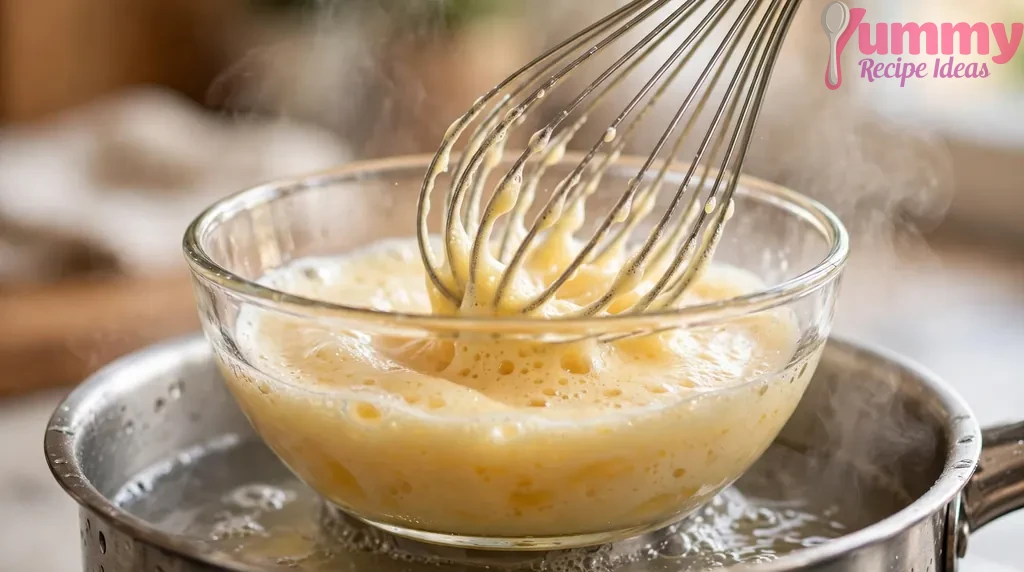
- Whisk the yolks to a foam: Whisk the yolks and vinegar over the simmering water for 3 to 4 minutes until they turn pale golden, thick and foamy — when you lift the whisk, the ribbon should hold for a second before dissolving. If the eggs start cooking at the edges, lift the bowl off the heat for a few seconds, keep whisking, then set it back down. You are warming the yolks, not cooking them.
- Add the butter with the heat OFF: Take the bowl completely off the pan and turn the heat off. Whisking constantly, drizzle in the warm melted butter in a slow, thin stream — drops at first, then a thread. Do not stop whisking, and do not pour the butter in all at once, or the sauce will break. The sauce should thicken to the consistency of mayonnaise. Leave the milky solids settled at the bottom of the melting pan.
- Season and thin: Whisk in the 1 tbsp lemon juice, the 1/2 tsp kosher salt and several grinds of black pepper. Taste: it should be bright and buttery with a gentle vinegar hum. If it is too thick, whisk in 1 to 2 tsp warm water. If it needs more zing, add lemon juice a teaspoon at a time.
- Hold warm, not hot: Serve right away if you can. If the meal needs a few minutes, cover the bowl with a clean kitchen towel and set it back over the warm (not simmering) water with the heat off — it holds for up to 30 minutes. Never refrigerate it and never reheat it over direct heat; both will split it.
Ingredients
For the hollandaise:
- 3 large egg yolks, at room temperature
- 2 tsp tarragon vinegar (or white wine vinegar)
- 3/4 cup plus 2 tbsp unsalted butter (1 3/4 sticks), melted and warm
- 1 tbsp fresh lemon juice, plus more to taste
- 1/2 tsp kosher salt
- Freshly ground black pepper
- 1 to 2 tsp warm water, if needed, to thin
You will need:
- Small saucepan (for the bain-marie)
- Medium heatproof bowl (glass or metal) that sits snugly over the saucepan without touching the water
- Balloon whisk
- Small ladle or measuring cup (for drizzling in the butter)
- Small saucepan or microwave-safe cup (for melting the butter)
Directions
- Set up the bain-marie: Pour about 1 inch of water into the small saucepan and bring it to a bare simmer — lazy bubbles, not a rolling boil. Set the heatproof bowl over the pan; the bottom of the bowl must sit above the water, never touching it. Put the 3 egg yolks and the 2 tsp tarragon vinegar into the bowl.
- Whisk the yolks to a foam: Whisk the yolks and vinegar over the simmering water for 3 to 4 minutes until they turn pale golden, thick and foamy — when you lift the whisk, the ribbon should hold for a second before dissolving. If the eggs start cooking at the edges, lift the bowl off the heat for a few seconds, keep whisking, then set it back down. You are warming the yolks, not cooking them.
- Add the butter with the heat OFF: Take the bowl completely off the pan and turn the heat off. Whisking constantly, drizzle in the warm melted butter in a slow, thin stream — drops at first, then a thread. Do not stop whisking, and do not pour the butter in all at once, or the sauce will break. The sauce should thicken to the consistency of mayonnaise. Leave the milky solids settled at the bottom of the melting pan.
- Season and thin: Whisk in the 1 tbsp lemon juice, the 1/2 tsp kosher salt and several grinds of black pepper. Taste: it should be bright and buttery with a gentle vinegar hum. If it is too thick, whisk in 1 to 2 tsp warm water. If it needs more zing, add lemon juice a teaspoon at a time.
- Hold warm, not hot: Serve right away if you can. If the meal needs a few minutes, cover the bowl with a clean kitchen towel and set it back over the warm (not simmering) water with the heat off — it will hold for up to 30 minutes. Never put it in the fridge and never reheat it over direct heat; both will split it.
Split rescue: If the sauce separates into greasy clumps, do not throw it away. Put 1 fresh egg yolk (or 1 tbsp of hot water) in a clean bowl, then drizzle the split sauce into it in a slow stream while whisking constantly — the emulsion rebuilds in under a minute. See the FAQ below for the full fix.

FAQs
Why does Ramsay take the bowl off the heat before adding the butter?
Because heat is what breaks hollandaise, and he removes the danger before it can strike. Egg yolks start scrambling around 160°F, and a bowl sitting over simmering water is a few whisk-strokes away from that line. Ramsay builds the foam over gentle heat first — that is the only hot step — then lifts the bowl off the pan and kills the burner entirely. From there, the residual warmth of the yolks is enough to absorb the butter into a stable emulsion. Pouring butter into a bowl that is still sitting over active steam is the number-one reason home hollandaise turns grainy or splits: the emulsion cannot form faster than the heat cooks the yolks. The trick is to whisk without stopping while you drizzle, because constant motion is what wraps each fat droplet in yolk proteins. If your kitchen runs hot or the butter is very warm, pause and let the butter cool for 30 seconds before you start — warm, not hot, is the target. Once the sauce thickens like mayonnaise, it is stable at room temperature for your whole brunch.
My hollandaise split — can I fix it, or do I start over?
You can almost always fix it, and Ramsay-trained cooks expect it to happen sometimes. A split looks like greasy liquid pooling around yellow curds; it means the emulsion lost its grip, usually from too much heat or butter added too fast. Fix one: put 1 fresh egg yolk in a clean bowl and drizzle the broken sauce into it, a teaspoon at a time at first, whisking constantly — the fresh yolk gives the butter something new to cling to, and the sauce comes back together in about a minute. Fix two, the quicker one: put 1 tbsp of very hot water in a clean bowl and whisk the split sauce into it drop by drop; the hot water loosens the yolks and lets them re-emulsify the butter. Start with the hot-water fix if the split is mild (just a little oily sheen), and use the fresh-yolk fix if it has fully separated into curds and oil. Once rescued, treat the sauce gently: keep it off the heat and serve soon. And never try to fix a split by reheating it over the stove — more heat is exactly what broke it, and more heat will only finish the job.
Can I use white wine vinegar instead of tarragon vinegar?
Yes — white wine vinegar is the exact substitute Ramsay himself reaches for when tarragon vinegar is not on hand. Tarragon vinegar is simply white wine vinegar that has been infused with fresh tarragon, and Ramsay uses it because its faint anise note is the signature flavor behind classic French hollandaise. It is why restaurant hollandaise tastes like more than just lemony butter. But white wine vinegar works beautifully on its own: you still get the clean acidity the sauce needs to cut through all that butter. What you should not swap in is distilled white vinegar, which is too harsh, or apple cider vinegar, whose fruitiness clashes with the lemon. If you want the tarragon character without buying a whole bottle, add 1 tsp of finely chopped fresh tarragon to the finished sauce — it reads as the same flavor. And if you are cooking for someone who dislikes that licorice note entirely, white wine vinegar alone makes a brighter, simpler sauce that is arguably better over steamed asparagus.
How do I keep hollandaise warm without it splitting, and how long does it hold?
Keep it warm, never hot, and never for longer than 30 minutes. The safe setup is exactly the bain-marie from the recipe: the finished sauce, covered with a clean kitchen towel, sits over the warm water with the burner turned completely off. The towel traps gentle warmth and stops a skin forming; the turned-off water keeps it just above room temperature without cooking the yolks any further. A thermos or insulated pitcher also works well for transport — pour the sauce in warm and it will hold for a brunch buffet. What kills it is direct heat: do not put the bowl back on a lit burner, do not microwave it, and do not set it in a hot oven to wait. And do not refrigerate it thinking you will reheat it later; cold hollandaise firms into butter and reheating always splits it. If the sauce thickens while holding, whisk in a teaspoon of warm water to loosen it. Make your hollandaise last in your timeline, right before the eggs are poached — it takes 10 minutes, so there is no reason to rush it.
What do you serve hollandaise with besides eggs benedict?
Eggs benedict is the headline act, but this sauce is a whole wardrobe. The classic trio is eggs, asparagus and salmon — all three have a richness that the lemon in hollandaise cuts through perfectly. Spoon it over steamed or grilled asparagus with a squeeze of extra lemon; pour it over pan-seared salmon fillets instead of a cream sauce; or drizzle it over roasted broccoli, which becomes a completely different dish under a warm buttery blanket. It is also the sauce on steak oscar (filet topped with crab), it turns plain steamed artichokes into an appetizer, and it makes a breakfast burrito taste like room service. For a special-occasion plate, it is the natural partner for our Gordon Ramsay Lobster Wellington — the rich pastry and lobster beg for exactly this kind of bright, buttery sauce. One practical tip: serve hollandaise warm, not piping hot, and spoon it at the table. It looks and tastes best fresh from the bowl, before it has time to firm up.
Can I make hollandaise ahead, store it, or freeze it — and what about an olive-oil version?
Honestly, no — hollandaise is a make-it-fresh sauce, and that is the tradeoff for its texture. It does not refrigerate well (it firms into solid butter and reheating splits it) and it does not freeze at all. At most, you can hold it warm for 30 minutes with the method above. If you need a sauce you can genuinely make ahead, make our Gordon Ramsay Basil Pesto instead — it keeps for days in the fridge and only gets better. What you can prep ahead for hollandaise: separate the yolks, melt the butter, juice the lemon and set up the bain-marie before guests arrive — then the actual cooking takes 10 minutes. As for an olive-oil version, it exists (sometimes called a mock or olive-oil hollandaise), but it is a different sauce: olive oil’s strong, fruity flavor overpowers the delicate yolk-and-lemon balance that makes hollandaise what it is, and it is harder to emulsify. If you try it, use a mild light olive oil, never extra-virgin. Butter is the right fat here.
About Yummy Recipe Ideas: We test and share easy, flavor-packed recipes inspired by the world’s best chefs — written for real home kitchens with US measurements and honest costs. New recipes every day.
