
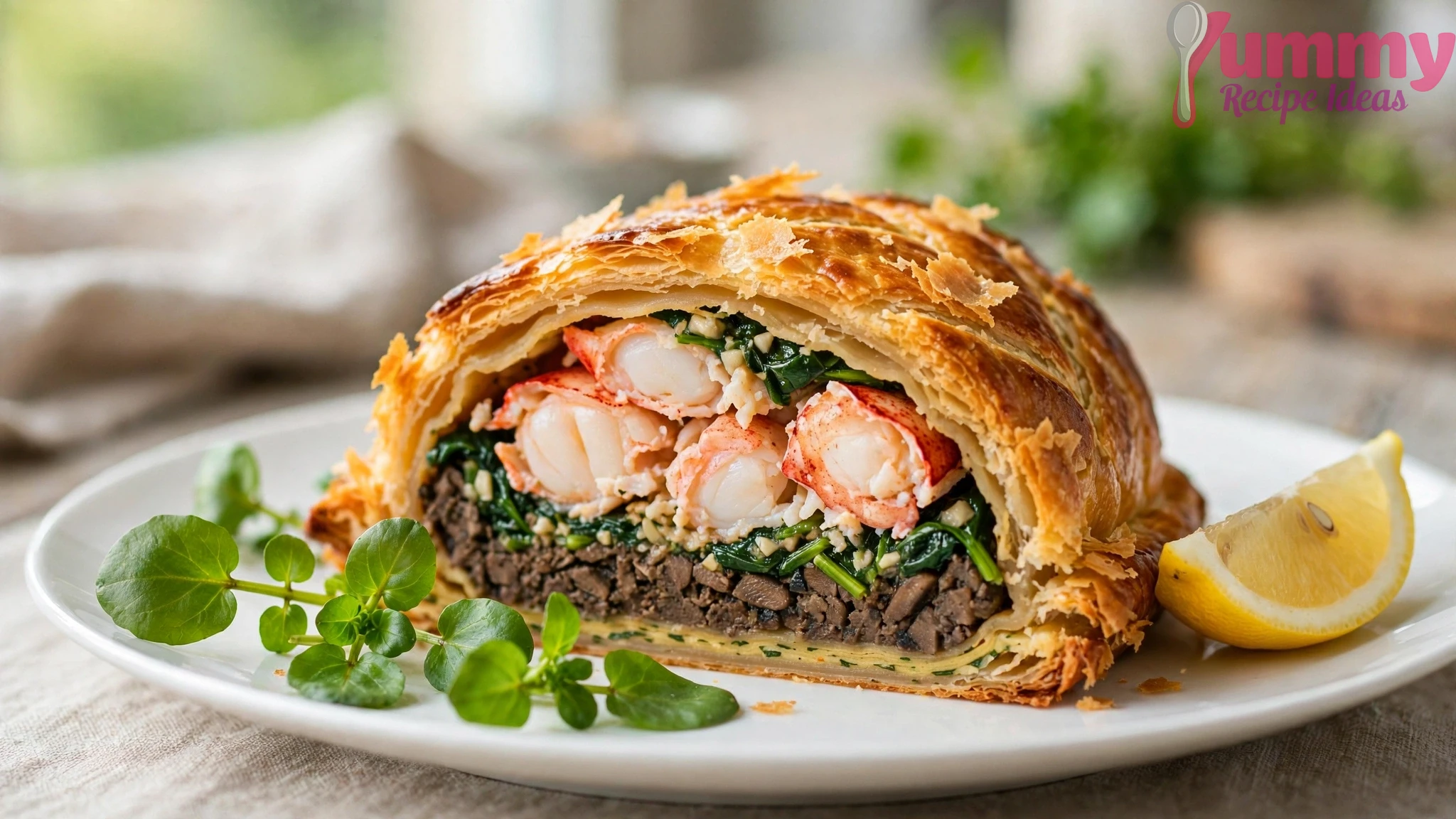
Gordon Ramsay’s lobster wellington wraps sweet lobster tails in garlic spinach, mushroom duxelle and a herbed crepe, then bakes the whole thing in golden puff pastry for 20 to 25 minutes. It is the most luxurious wellington he has ever put on a menu — and it takes under an hour, which no beef wellington can say.
Ramsay served this at Bread Street Kitchen during his #BeefWellingtonWeek series, and the method pulls tricks from across his cookbooks: the lobster prep follows his Bread Street Kitchen approach — a brief boil in salted lemon water with thyme, shelled carefully, meat kept whole — while the pastry wrapping borrows the Sunday Lunch crepe technique from his beef and salmon wellingtons. The standout move is the crepe itself: a thin chive-flecked barrier between the lobster and the pastry that keeps the crust shatteringly crisp.
The key difference from the beef version is speed. The lobster is already par-cooked before it goes into the pastry, so the oven time only has to crisp the puff and warm the filling through — about 20 minutes at 425°F. Overbake it and the lobster turns rubbery, which is the one thing that can ruin this dish. Get it right and you slice into flaky golden pastry to find whole, sweet lobster tails waiting inside. Yes, it is a splurge — about $12.50 a serving — but for a dinner party centerpiece, nothing else comes close.
Cooked this recipe? Send a photo — we’d love to feature your version!
Gordon Ramsay Lobster Wellington Recipe
Recipe by Yummy Recipe Ideas · Course: Main Dish · Cuisine: British · Servings: 4 · Prep: 30 min · Cook: 25 min · Total: 55 min + 35 min chilling · Calories: 580 kcal · Difficulty: Intermediate
Lobster tails wrapped in garlic spinach, mushroom duxelle and a herbed crepe, baked in golden puff pastry. The most luxurious wellington — ready in under an hour plus chilling. Serves 4.
Ingredients
For the lobster:
- 4 lobster tails, about 5 oz each (about 1 1/4 lb total)
- Juice of 1 lemon
- 1 1/2 tsp kosher salt, divided
- 2 fresh thyme sprigs
For the spinach and duxelle:
- 7 oz cremini or chestnut mushrooms, very finely chopped
- 1 thyme sprig, leaves only
- 5 oz baby spinach
- 2 garlic cloves, finely chopped
- 2 tbsp unsalted butter
- Zest of 1/2 lemon
- Kosher salt and freshly ground black pepper
For the herbed crepe:
- 1/2 cup all-purpose flour
- 1 large egg
- 1/2 cup plus 1 tbsp whole milk
- 1 tbsp fresh chives, finely chopped
- Pinch of kosher salt
For the pastry:
- 1 sheet puff pastry (about 14 oz), thawed if frozen
- 1 large egg yolk, beaten, for the egg wash
Directions
- Par-cook the lobster: Bring a large pot of water to a rolling boil with the lemon juice, 1 tsp of the salt and the thyme sprigs. Drop in the lobster tails and cook for exactly 4 minutes, until the shells turn bright orange. Drain, cool slightly, then carefully work the meat out of the shells in one piece. Pat completely dry and set aside.
- Dry-roast the duxelle: Put the finely chopped mushrooms in a dry skillet over high heat with the thyme leaves, a pinch of salt and a few grinds of pepper. Cook, stirring often, for 8 to 10 minutes until all the moisture has cooked off and you have a dark, dry paste. Spread it on a plate and let it cool completely.
- Wilt the spinach: Melt the butter in the same skillet over medium heat. Add the garlic and cook for 30 seconds, then pile in the spinach and toss for about 1 minute until just wilted. Transfer to a sieve, drain well, then squeeze out every last drop of water with your hands. Chop, mix with the lemon zest, and season with salt and pepper.
- Make the herbed crepe: Whisk the flour, egg, milk, chives and salt until completely smooth. Ladle a thin layer into a hot nonstick pan, swirling to coat, and cook for 1 to 2 minutes per side until golden. You need one large crepe — leave it to cool.
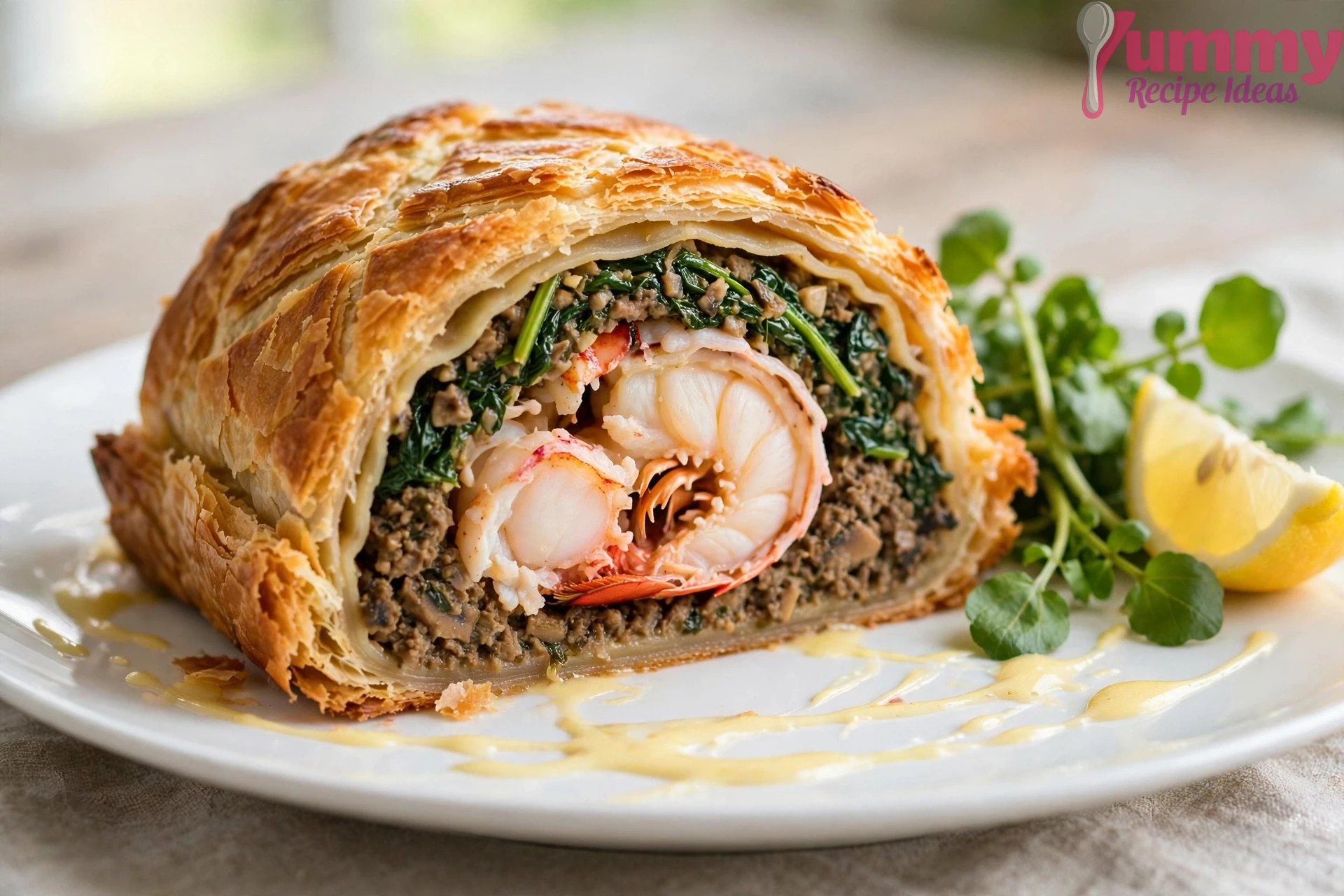
- Roll the log: Lay a large sheet of plastic wrap on the work surface and place the crepe flat on top. Spread the spinach in an even layer over the crepe, then spread the cooled duxelle over the spinach. Lay the four lobster tails end to end in a line down the center and season with the remaining 1/2 tsp salt and pepper. Use the plastic wrap to roll everything into a tight, neat log, twisting the ends like a cracker. Chill for 20 minutes.
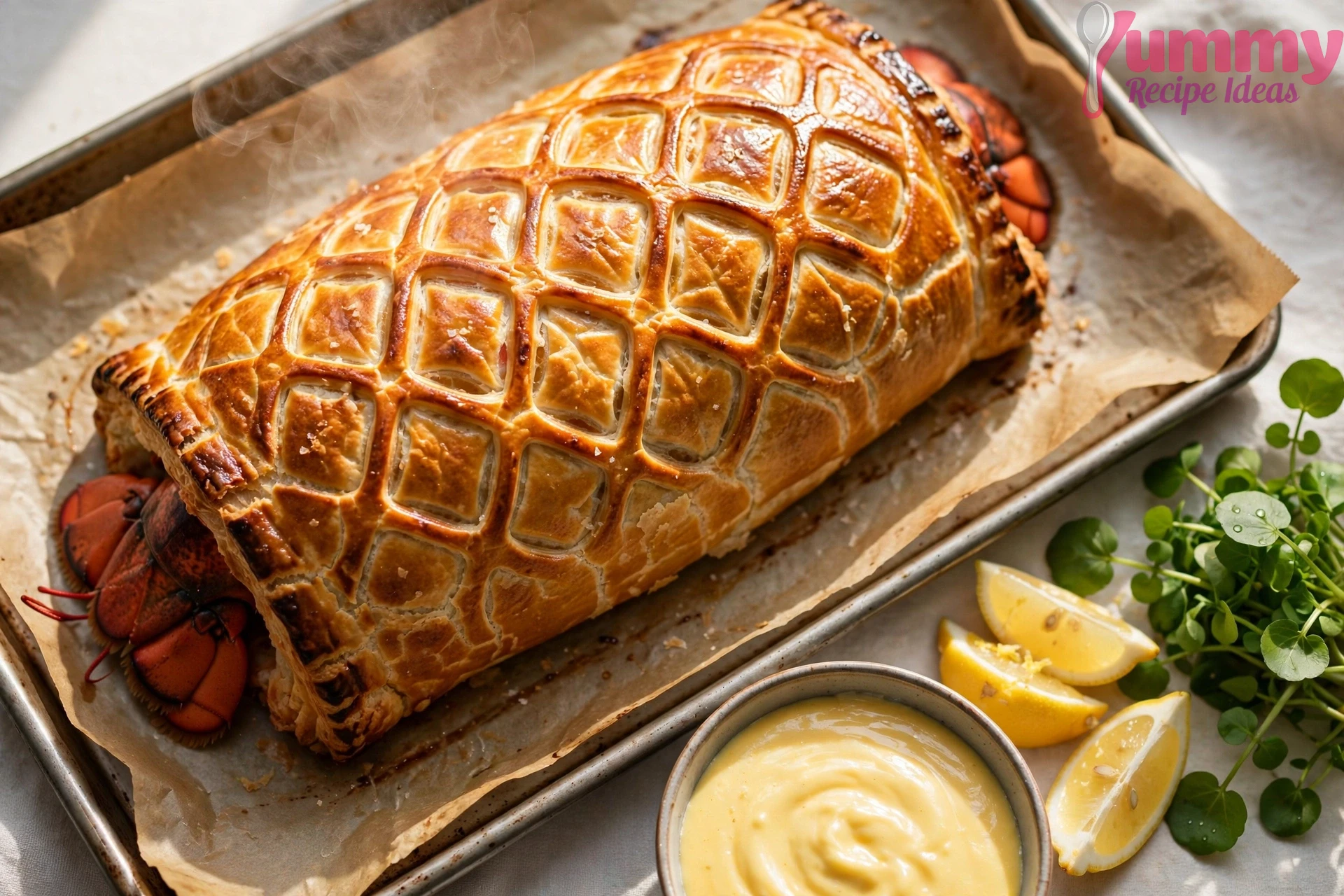
- Wrap in pastry: Roll the puff pastry out on a floured surface to about 1/8 inch thick. Unwrap the lobster log, place it seam-side down on the pastry, and brush the pastry edges with beaten egg yolk. Fold the pastry around the log, press to seal, and trim the excess. Turn seam-side down onto a parchment-lined baking sheet. Brush all over with egg wash and chill for 15 minutes — cold pastry bakes flakier.
- Bake golden and rest: Heat the oven to 425°F. Score the pastry lightly in a crisscross or lattice pattern with the back of a knife (do not cut through), then egg wash once more. Bake for 20 to 25 minutes until deeply golden and puffed. Rest for 5 minutes before slicing into thick portions with a sharp serrated knife.
Gordon Ramsay Lobster Wellington Recipe
Ingredients
Equipment
Method
- Par-cook the lobster: Bring a large pot of water to a rolling boil with the lemon juice, 1 tsp of the salt and the thyme sprigs. Drop in the lobster tails and cook for exactly 4 minutes, until the shells turn bright orange. Drain, cool slightly, then carefully work the meat out of the shells in one piece. Pat completely dry and set aside.
- Dry-roast the duxelle: Put the finely chopped mushrooms in a dry skillet over high heat with the thyme leaves, a pinch of salt and a few grinds of pepper. Cook, stirring often, for 8 to 10 minutes until all the moisture has cooked off and you have a dark, dry paste. Spread it on a plate and let it cool completely.
- Wilt the spinach: Melt the butter in the same skillet over medium heat. Add the garlic and cook for 30 seconds, then pile in the spinach and toss for about 1 minute until just wilted. Transfer to a sieve, drain well, then squeeze out every last drop of water with your hands. Chop, mix with the lemon zest, and season with salt and pepper.
- Make the herbed crepe: Whisk the flour, egg, milk, chives and salt until completely smooth. Ladle a thin layer into a hot nonstick pan, swirling to coat, and cook for 1 to 2 minutes per side until golden. You need one large crepe — leave it to cool.
- Roll the log: Lay a large sheet of plastic wrap on the work surface and place the crepe flat on top. Spread the spinach in an even layer over the crepe, then spread the cooled duxelle over the spinach. Lay the four lobster tails end to end in a line down the center and season with the remaining 1/2 tsp salt and pepper. Use the plastic wrap to roll everything into a tight, neat log, twisting the ends like a cracker. Chill for 20 minutes.
- Wrap in pastry: Roll the puff pastry out on a floured surface to about 1/8 inch thick. Unwrap the lobster log, place it seam-side down on the pastry, and brush the pastry edges with beaten egg yolk. Fold the pastry around the log, press to seal, and trim the excess. Turn seam-side down onto a parchment-lined baking sheet. Brush all over with egg wash and chill for 15 minutes — cold pastry bakes flakier.
- Bake golden and rest: Heat the oven to 425°F. Score the pastry lightly in a crisscross or lattice pattern with the back of a knife (do not cut through), then egg wash once more. Bake for 20 to 25 minutes until deeply golden and puffed. Rest for 5 minutes before slicing into thick portions with a sharp serrated knife.
FAQs
Why do you par-cook the lobster before wrapping it?
Because raw lobster is full of water, and water is the enemy of puff pastry. If you wrap raw tails in pastry and bake them, the lobster releases all of its liquid as it cooks, and instead of a crisp, flaky crust you get a pale, soggy parcel — the classic failed wellington. A quick 4-minute boil in salted lemon water sets the proteins just enough to lock that moisture in, while the lobster still has one more gentle cooking to come inside the hot pastry during the bake. Four minutes is deliberate: the shells turn bright orange and the meat firms up, but it is still slightly underdone in the center, so the final 20 to 25 minutes in the oven finish it to sweet, tender perfection instead of rubbery overcooked seafood. And do not throw the shells away — they are packed with flavor and make a brilliant lobster bisque as a starter the next day, which turns one expensive ingredient into two courses. Save the bisque-making instinct for another day though: our Gordon Ramsay Bouillabaisse is the perfect place to put good seafood shells and stock to work.
Can you use frozen lobster tails?
Yes, and most home cooks will — good fresh lobster tails are hard to find outside coastal cities, and frozen ones are often frozen at sea within hours of catching, which can actually mean fresher flavor than “fresh” tails that have sat in a case for days. Thaw them fully in the fridge overnight, never on the counter or in warm water, which makes the texture mushy. The critical step is drying: frozen tails hold more water than fresh ones, so after shelling, pat them very thoroughly with paper towels and even let them sit on a rack in the fridge for 20 minutes. Any surface moisture will steam inside the pastry and threaten the crisp crust you are working for. Size matters too — aim for 5-oz tails so the four of them make a neat, even log; tiny 3-oz tails cook through too fast in the oven and turn rubbery before the pastry is golden. Buy them shell-on for this recipe, since the par-cooking step needs the shell for protection and the shells give you that bonus bisque stock.
What is the crepe actually for?
The crepe is the moisture barrier, and it is the quiet genius of every Ramsay wellington — beef, salmon or lobster. Puff pastry and wet filling are natural enemies: any liquid that migrates into the dough turns it gummy and gray instead of crisp and golden. The thin herbed crepe sits between the filling and the pastry and absorbs that migrating moisture before it can reach the dough, so the crust stays shatteringly flaky all the way around. It is the same Sunday Lunch technique Ramsay uses in his beef wellington, just adapted here with chives folded into the batter for an oniony freshness that suits seafood. A plain crepe works fine if you skip the chives, and in a pinch you could even use a very thin layer of prosciutto as the barrier — but the crepe is cheaper, easier to roll, and soaks up juice without adding competing flavor. Do not skip it and do not substitute phyllo, which shatters instead of flexing when you roll the log.
What do you serve with lobster wellington?
Keep the sides simple and green — the pastry is rich and filling enough on its own. Ramsay’s style pairing is buttered samphire or steamed asparagus with a squeeze of lemon, and a light hollandaise on the side works beautifully because it matches the richness without competing with it. Avoid anything heavy like roast potatoes or creamy gratins: the dish already has pastry, butter and duxelle, and a starchy side turns a luxurious main into a nap. A crisp green salad is the other classic move — our Gordon Ramsay Rocket Salad with its peppery bite and sharp dressing cuts through the richness perfectly. For wine, pour something cold and unoaked: a Muscadet, a Chablis, or a good Champagne if it is a celebration. And slice at the table — the cross-section of pink lobster against green spinach and golden pastry is half the drama, so let people see it.
What is the difference between lobster wellington and lobster en croûte?
They are close cousins, but the technique is different. A wellington always means puff pastry wrapped around a filling that includes a duxelle — that finely chopped mushroom mixture — plus a moisture barrier like a crepe or prosciutto, rolled and baked as a whole parcel. “En croûte” just means “in a crust” in French, and it can use any pastry — shortcrust, puff, even brioche dough — with any filling at all, no duxelle or barrier required. So every lobster wellington is technically a lobster en croûte, but not every en croûte earns the wellington name. In practice, most people use the terms interchangeably for lobster because there is no centuries-old tradition for it the way there is for beef wellington — Ramsay’s Bread Street Kitchen version essentially invented the modern lobster wellington format during his wellington week series. If you want to compare it against his most famous parcel of all, there is no contest for effort: the beef version takes hours, the lobster one takes under an hour.
Can you make lobster wellington ahead of time?
Partially — and knowing where to stop is the whole trick. You can assemble the entire parcel through the pastry-wrapping step a full day ahead: roll the log, wrap it in pastry, egg wash it, and keep it uncovered in the fridge overnight (uncovered so the pastry surface dries slightly and bakes up crisper). Then bake straight from the fridge, adding 3 to 5 minutes to the oven time. What you cannot do is bake it ahead: reheated puff pastry goes soft and the lobster overcooks in the second heating, so it must be served fresh from the oven after its 5-minute rest. The components can also be prepped separately — duxelle and spinach a day ahead, crepe a day ahead, lobster par-cooked the morning of. Leftovers keep one day in the fridge and reheat best in a 350°F oven for 10 minutes, never the microwave. For another make-ahead-friendly showstopper from the same price bracket, our Gordon Ramsay Bouillabaisse can be made 2 days ahead through the blending step.
About Yummy Recipe Ideas: We test and share easy, flavor-packed recipes inspired by the world’s best chefs — written for real home kitchens with US measurements and honest costs. New recipes every day.
